AI SEO vs Traditional SEO: What’s the Difference?
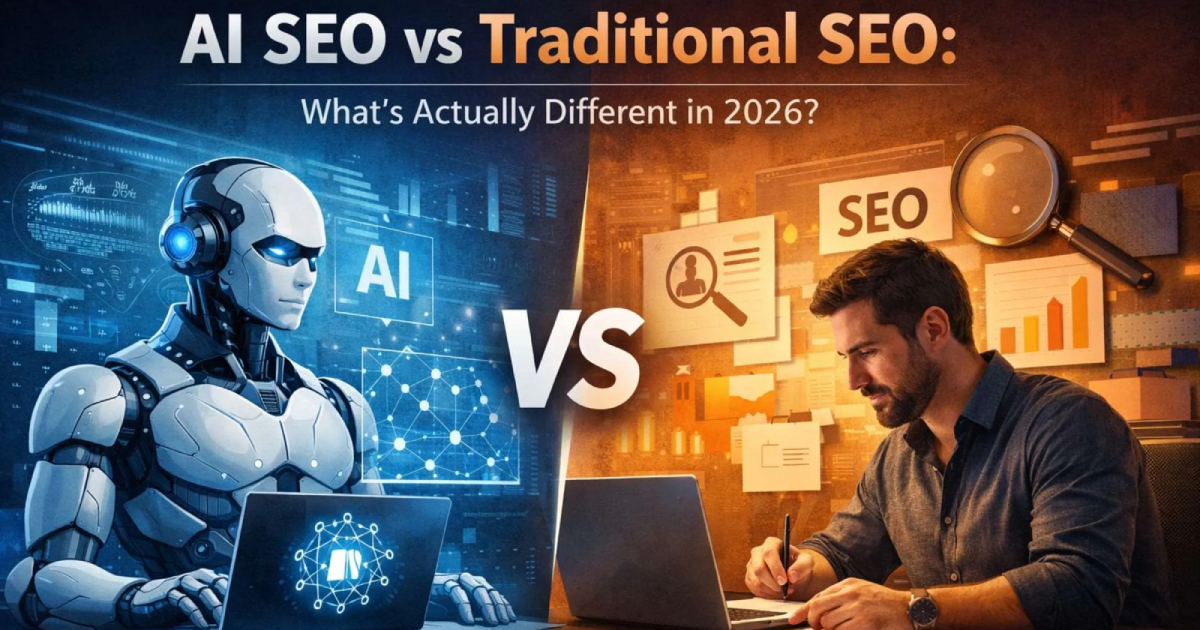
Compare AI SEO vs traditional SEO, including keywords, content, technical SEO, AI search visibility, GEO, AEO, and modern search strategies.
AI SEO vs Traditional SEO: An Overview
Traditional SEO is the process of optimizing a website to improve its visibility in search engine results. It focuses on areas such as keywords, content, technical SEO, backlinks, search intent, and website structure.
AI SEO builds on these foundations while considering how modern AI-powered search systems understand, summarize, and present information.
AI SEO does not replace traditional SEO. Instead, it expands the optimization process to account for AI-powered search, conversational queries, entities, semantic relationships, and generative search experiences.
Businesses looking to combine both approaches can explore our AI SEO Services.
What Is Traditional SEO?
Traditional SEO focuses on improving a website's ability to appear in organic search results.
A traditional SEO strategy can include:
- Keyword research
- Search-intent analysis
- On-page optimization
- Technical SEO
- Content creation
- Internal linking
- Link building
- Website architecture
- Local SEO
- Performance monitoring
The goal is to help search engines understand a website and match its pages with relevant searches.
What Is AI SEO?
AI SEO is a broader approach that combines traditional SEO with AI-assisted optimization and strategies designed for modern AI-powered search experiences.
It can involve:
- AI-assisted keyword research
- Search-intent analysis
- Semantic SEO
- Entity optimization
- AI content optimization
- Topical authority
- AI search visibility
- Generative Engine Optimization
- Answer Engine Optimization
- LLM-focused optimization
The objective is to make information easier for both search engines and AI-powered systems to understand and use.
Learn more about What Is AI SEO?
AI SEO vs Traditional SEO
The biggest difference is not that one uses AI and the other does not.
Traditional SEO and AI SEO can both use artificial intelligence tools.
The difference is primarily in what the optimization strategy is designed to achieve.
| Traditional SEO | AI SEO |
|---|---|
| Focuses primarily on search engine visibility | Focuses on search and AI-powered visibility |
| Strong emphasis on keywords | Strong emphasis on topics, entities, and intent |
| Optimizes webpages | Optimizes information and relationships across content |
| Focuses heavily on traditional SERPs | Considers SERPs and AI-powered search |
| Organic rankings are a major metric | Rankings plus AI visibility can be considered |
| Content targets search queries | Content can target queries, questions, entities, and conversational searches |
| Technical SEO remains important | Technical SEO remains important |
| Links and authority matter | Authority, entities, content, and broader signals matter |
What Is the Difference Between AI SEO and Traditional SEO?
Search Behavior
Traditional SEO often begins with keyword-based searches.
AI-powered search allows users to ask longer, conversational questions.
For example, instead of searching:
best CRM software
a user might ask:
What is the best CRM for a small B2B company with a five-person sales team?
AI SEO considers these conversational and question-based search behaviors.
Keyword Research in Traditional SEO vs AI SEO
Traditional keyword research commonly focuses on:
- Search volume
- Keyword difficulty
- Competition
- Cost per click
- Search intent
- Related keywords
AI SEO can expand this process by identifying:
- Conversational queries
- Related questions
- Semantic concepts
- Entities
- Topic relationships
- Search journeys
- Content gaps
This doesn't make traditional keyword research obsolete.
Instead, AI can make the research process more comprehensive.
Explore our AI Keyword Research guide.
Content Strategy: Traditional SEO vs AI SEO
Traditional SEO content is generally created to satisfy search intent and rank for relevant queries.
AI SEO takes a broader approach to content architecture.
Instead of creating individual articles around isolated keywords, content can be organized into interconnected topic clusters.
For example:
AI SEO Services
        ↓
AI SEO Strategy
        ↓
AI Keyword Research
        ↓
Semantic SEO
        ↓
Topical Authority
        ↓
AI Content Optimization
This structure helps establish relationships between related subjects.
Learn more about SEO Topic Clusters.
Semantic SEO in AI SEO
Semantic SEO focuses on understanding the meaning and relationships between concepts.
For example, a page about AI SEO may naturally discuss:
- Search engines
- Artificial intelligence
- Search intent
- Keywords
- Content
- Entities
- Semantic search
- AI search
- Generative search
These related concepts help provide context around the primary topic.
Explore our guide to Semantic SEO.
Technical SEO in AI SEO
Technical SEO remains important regardless of whether you call your strategy traditional SEO or AI SEO.
A website still needs to be:
- Crawlable
- Indexable
- Accessible
- Mobile-friendly
- Fast
- Well structured
Technical optimization can include:
- XML sitemaps
- Robots directives
- Canonical tags
- Structured data
- Site architecture
- Internal linking
- Page performance
- Indexation management
AI SEO does not eliminate the technical foundations of SEO.
Internal Linking in AI SEO
Internal linking helps connect related pages across your website.
A traditional website might link pages primarily to help users navigate.
AI SEO can use internal linking as part of a broader topic architecture.
For example:
→ AI SEO Strategy
→ AI Keyword Research
→ Semantic SEO
→ Topical Authority
→ AI Content Optimization
→ GEO
→ AEO
→ AI Search Visibility
This creates clear relationships between related topics.
AI SEO, AEO and GEO
AI SEO is often discussed alongside AEO and GEO.
Answer Engine Optimization
AEO focuses on providing information that can be used to answer questions directly.
Generative Engine Optimization
GEO focuses on improving visibility within generative AI search experiences.
AI SEO
AI SEO is the broader approach that can include traditional SEO, AEO, GEO, semantic SEO, entity optimization, content optimization, and AI-assisted SEO workflows.
Learn more about Answer Engine Optimization and Generative Engine Optimization.
Does AI SEO Replace Traditional SEO?
No.
Traditional SEO remains the foundation of a successful search strategy.
A website still needs:
- Strong technical foundations
- Useful content
- Relevant keywords
- Good search intent alignment
- Clear website architecture
- Internal links
- Authority
- Good user experience
AI SEO adds additional considerations for modern search behavior and AI-powered discovery.
The best approach is therefore:
Traditional SEO + AI SEO
rather than:
Traditional SEO vs AI SEO
Benefits of Combining Traditional SEO and AI SEO
Using both approaches can help businesses create a more complete search strategy.
Broader Search Visibility
Your content can be optimized for traditional search results while also considering AI-powered search experiences.
Better Content Planning
AI-assisted research can help identify questions, topics, entities, and content gaps.
Stronger Topical Coverage
Topic clusters can connect related content and establish comprehensive coverage.
Better Understanding of Search Intent
Conversational searches can reveal more detailed user needs.
More Efficient SEO Workflows
AI tools can assist with research, analysis, clustering, content briefs, and optimization.
Stronger Information Architecture
Semantic relationships and internal links can help organize related information.
How to Combine AI SEO With Traditional SEO
A practical strategy can follow these steps.
Start With Technical SEO
Make sure search engines can access and understand your website.
Research Keywords and Search Intent
Identify the searches that matter to your audience.
Build Topic Clusters
Group related keywords and questions around broader topics.
Create Useful Content
Develop content that answers users' questions clearly and comprehensively.
Optimize for Semantic Relationships
Cover relevant concepts and entities naturally.
Strengthen Internal Linking
Connect pages that are logically related.
Optimize for AI Search
Structure useful information so that it can be easily understood within modern search experiences.
Monitor Performance
Track organic rankings, traffic, conversions, and relevant AI-search visibility signals.
For a complete framework, explore our AI SEO Strategy guide.
Which Is Better: AI SEO or Traditional SEO?
There is no need to choose one.
Traditional SEO provides the foundation, while AI SEO expands the strategy to account for changing search behavior and AI-powered discovery.
For most businesses, the strongest approach is to combine:
Technical SEO + Content SEO + Semantic SEO + Entity SEO + AI Search Optimization
This creates a more comprehensive search strategy.
Common Mistakes When Switching to AI SEO
Abandoning Traditional SEO
AI SEO should not mean ignoring technical SEO, keywords, content quality, or website architecture.
Publishing Mass AI Content
Using AI to produce large volumes of low-quality content does not create a strong SEO strategy.
Focusing Only on ChatGPT
AI search includes multiple platforms and evolving search experiences.
Ignoring Search Intent
AI tools do not eliminate the need to understand what users actually want.
Keyword Stuffing
Repeating AI-related keywords unnecessarily can make content unnatural and less useful.
Creating Separate Pages for Every Tiny Keyword
Not every keyword needs its own page. Closely related searches can often be addressed through comprehensive content.
Build a Modern SEO Strategy
The future of search is not simply about choosing between traditional SEO and AI SEO.
The strongest strategy combines the technical and content foundations of traditional SEO with modern approaches to semantic search, entities, conversational queries, and AI-powered discovery.
If you want to build this approach for your website, explore our AI SEO Services.