AI SEO Audit: Complete Guide to Auditing Your Website
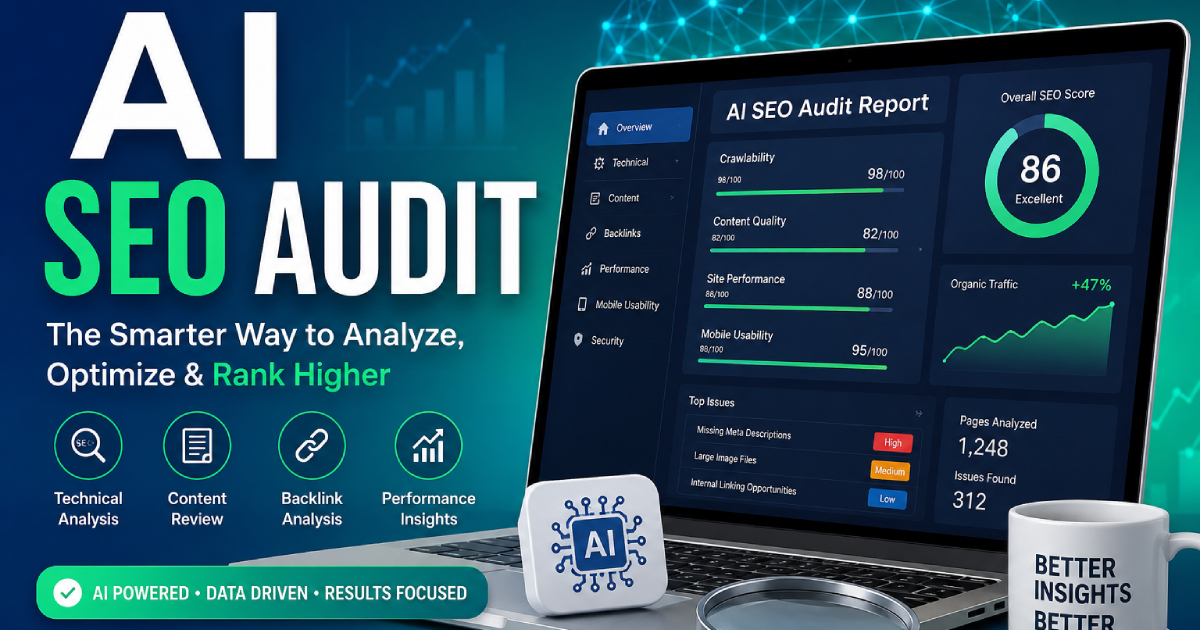
Learn how an AI SEO audit works and how to identify technical, content, keyword, semantic, entity, and AI search optimization opportunities.
What Is an AI SEO Audit?
An AI SEO audit is a detailed analysis of a website's SEO performance, content, technical structure, search visibility, and readiness for AI-powered search experiences.
A traditional SEO audit may focus on areas such as:
- Technical SEO
- Keywords
- Content
- Backlinks
- Website structure
- Page speed
- Indexing
An AI SEO audit expands this analysis by also considering:
- Semantic relevance
- Search intent
- Entities
- Topical authority
- AI-search visibility
- Conversational queries
- AEO
- GEO
- Content quality
- Internal linking
The purpose is to identify what is working, what is missing, and what should be improved.
For a complete strategy that combines these areas, explore our AI SEO Services. (AI SEO Services)
Why Is an AI SEO Audit Important?
A website can have good rankings and still have opportunities to improve its visibility in newer search experiences.
For example, a website may:
- Rank for important keywords
- Have useful content
- Have good backlinks
but still lack:
- Strong topical coverage
- Clear entity information
- Conversational answers
- Logical internal linking
- AI-search-focused content
- Comprehensive topic clusters
An AI SEO audit helps identify these gaps.
It provides a structured starting point for improving both traditional search performance and AI-search visibility.
What Does an AI SEO Audit Include?
A comprehensive AI SEO audit can include:
- Technical SEO audit
- Website architecture analysis
- Keyword analysis
- Search-intent analysis
- Content audit
- Content-gap analysis
- Semantic SEO analysis
- Entity analysis
- Topical-authority analysis
- Internal-linking analysis
- AEO analysis
- GEO analysis
- AI-search visibility analysis
- Competitor analysis
- Local SEO analysis where relevant
- Conversion analysis
Each area provides a different piece of the overall picture.
AI SEO Audit vs Traditional SEO Audit
| Traditional SEO Audit | AI SEO Audit |
|---|---|
| Technical SEO | Technical SEO + AI-search readiness |
| Keyword rankings | Keywords + conversational queries |
| Content quality | Content + semantic relevance |
| Backlinks | Authority + information ecosystem |
| Internal links | Internal links + topical relationships |
| Search rankings | Search + AI visibility |
| Keywords | Keywords + entities + concepts |
| SERP analysis | SERP + AI-search analysis |
An AI SEO audit does not replace a traditional SEO audit.
It expands it.
Technical SEO Audit
Technical SEO provides the foundation for everything else.
An AI SEO audit should review areas such as:
Crawling
Can search-engine crawlers access important pages?
Indexing
Are important pages eligible to appear in search results?
Robots.txt
Are important resources accidentally blocked?
XML Sitemap
Does the sitemap accurately represent important URLs?
Canonicalization
Are canonical URLs correctly implemented?
Mobile Experience
Does the website work properly on mobile devices?
Page Speed
Do important pages load efficiently?
Core Web Vitals
Are key user-experience signals healthy?
HTTPS
Is the website secure?
Redirects
Are redirects working correctly without unnecessary chains?
Broken Links
Are users or crawlers encountering broken URLs?
Technical problems can limit the effectiveness of even excellent content.
Website Architecture Audit
Website structure determines how pages relate to one another.
A strong architecture might look like:
AI SEO Services
│
├── AI SEO Strategy
├── AI SEO Audit
├── AI Keyword Research
├── AI Content Optimization
├── Semantic SEO
├── Topical Authority
├── GEO
├── AEO
└── AI Search Visibility
This structure creates a clear relationship between the commercial hub and supporting informational pages.
Your AI SEO Services page should act as the central hub while cluster pages support individual subtopics. (AI SEO Services)
Keyword Audit
An AI SEO audit should examine whether your website is targeting the right keywords.
Review:
- Primary keywords
- Secondary keywords
- Long-tail keywords
- Question keywords
- Commercial keywords
- Informational keywords
- Local keywords
- Conversational queries
The goal is not to add as many keywords as possible.
The goal is to identify the keywords and topics that are genuinely relevant to the business.
Explore AI SEO Keyword Research.
Search Intent Audit
Every important keyword should be evaluated according to search intent.
Informational
The user wants to learn.
Example:
"What is AI SEO?"
Commercial
The user is researching solutions.
Example:
"Best AI SEO services"
Transactional
The user is ready to take action.
Example:
"AI SEO agency"
Navigational
The user is trying to find a particular website or brand.
Understanding intent helps determine which page should rank for which query.
Content Audit
The content audit evaluates whether your existing pages are useful and relevant.
Look for:
- Thin content
- Duplicate content
- Outdated information
- Missing sections
- Weak introductions
- Poor headings
- Keyword stuffing
- Search-intent mismatch
- Missing FAQs
- Weak calls to action
- Poor internal linking
The objective is to improve pages rather than simply increase the number of pages.
Explore AI Content Optimization.
Content Gap Analysis
Content gaps are subjects your audience may want to know about but your website does not adequately cover.
For example, an AI SEO website may have an AI SEO services page but no detailed resources about:
- AI SEO audits
- AI keyword research
- AI content optimization
- Semantic SEO
- Entity SEO
- Topical authority
- GEO
- AEO
- AI search visibility
These gaps can become new cluster topics.
The pages should then be connected naturally through internal linking.
Semantic SEO Audit
A semantic audit examines whether your content covers the important concepts related to the main topic.
For an AI SEO website, relevant concepts might include:
- Artificial intelligence
- Search engines
- AI platforms
- Search intent
- Semantic search
- Entities
- Content optimization
- Generative search
- Conversational search
- Topical authority
The goal is to build meaningful topical context rather than repeat keywords.
Explore Semantic SEO.
Entity SEO Audit
Entities help search systems understand who and what your website is about.
An entity audit can review:
- Company information
- Brand name
- Services
- Products
- People
- Locations
- Industry
- Organization information
For example, your website should clearly communicate:
Rank Up Webs → SEO agency → AI SEO services → AI search optimization
Clear relationships make the business easier to understand.
Explore Entity SEO.
Topical Authority Audit
A topical-authority audit examines how comprehensively your website covers an important subject.
For the AI SEO Services topic, your content architecture can include:
AI SEO Services
       ↓
AI SEO Strategy
       ↓
AI SEO Audit
       ↓
AI Keyword Research
       ↓
AI Content Optimization
       ↓
Semantic SEO
       ↓
Topical Authority
       ↓
GEO
       ↓
AEO
       ↓
AI Search Visibility
The important point is that these pages should provide different value.
Do not create multiple pages simply because they contain slightly different keyword variations.
Internal Linking Audit
Review whether related pages are connected appropriately.
For example:
AI SEO Audit can link to:
- AI SEO Services
- AI SEO Strategy
- AI Keyword Research
- AI Content Optimization
- Semantic SEO
- Topical Authority
- GEO
- AEO
- AI Search Visibility
The most important commercial link should point back to the main hub:
AI SEO Services
This creates a hub-and-cluster structure.
The main hub can then distribute users to supporting resources and supporting resources can naturally link back to the hub. (AI SEO Services)
AEO Audit
An AEO audit checks whether your content provides clear answers to important questions.
Review:
- Question-based headings
- Direct answers
- FAQ sections
- Definition sections
- Step-by-step explanations
- Clear formatting
- Conversational queries
For example:
What Is an AI SEO Audit?
An AI SEO audit evaluates a website's technical SEO, content, semantic relevance, entities, topical coverage, and AI-search readiness.
The answer should then be followed by deeper information.
Explore Answer Engine Optimization.
GEO Audit
A GEO audit examines how prepared your website is for generative search experiences.
It can evaluate:
- Content quality
- Entity clarity
- Topical authority
- Semantic relationships
- Brand information
- External references
- Conversational content
- AI-search visibility
Explore Generative Engine Optimization.
AI Search Visibility Audit
An AI search visibility audit evaluates how your brand appears when users ask relevant questions in AI-powered search experiences.
Create a list of important queries such as:
- What is AI SEO?
- What are the best AI SEO services?
- Which companies provide AI SEO services?
- How can businesses optimize for AI search?
- What is GEO?
- What is AEO?
Then monitor:
- Brand mentions
- Competitor mentions
- Brand descriptions
- References
- Citations where applicable
- Referral traffic
- Organic visibility
AI responses can change, so monitoring should be performed over time.
Explore AI Search Visibility.
Competitor AI SEO Audit
Competitor analysis can reveal opportunities that your website has not yet addressed.
Review competitor websites for:
- Content topics
- Keyword coverage
- Topic clusters
- Internal links
- Service pages
- FAQs
- Entity information
- Content depth
- Technical SEO
- AI-search positioning
The objective is not to copy competitors.
Instead, identify areas where your website can provide better, clearer, or more useful information.
How to Perform an AI SEO Audit
Step 1: Crawl the Website
Collect important information about pages, URLs, titles, headings, links, and technical elements.
Step 2: Review Technical SEO
Identify crawling, indexing, speed, mobile, redirect, sitemap, and structural issues.
Step 3: Analyze Keywords
Determine what the website currently ranks for and what relevant opportunities may be missing.
Step 4: Analyze Search Intent
Check whether pages match the intent behind their target queries.
Step 5: Audit Content
Find thin, outdated, duplicated, or incomplete content.
Step 6: Identify Content Gaps
Compare your coverage with the broader topic and relevant competitors.
Step 7: Analyze Semantic Coverage
Identify important concepts, entities, and relationships.
Step 8: Review Internal Links
Check whether related pages are connected logically.
Step 9: Evaluate AEO and GEO
Review answer-focused content and generative-search readiness.
Step 10: Create an Action Plan
Prioritize fixes according to impact, effort, business value, and urgency.
AI SEO Audit Report
A useful audit report should not simply list hundreds of errors.
It should explain:
| Area | Problem | Priority | Recommended Action |
|---|---|---|---|
| Technical SEO | Important pages difficult to crawl | High | Fix crawl issues |
| Content | Missing topic coverage | High | Create supporting content |
| Keywords | Poor intent targeting | High | Remap keywords |
| Internal Links | Related pages disconnected | Medium | Add contextual links |
| Entities | Business information unclear | Medium | Improve entity signals |
| AEO | Questions poorly answered | Medium | Add direct answers |
| GEO | Limited AI-search preparation | Medium | Improve semantic and topical coverage |
The most valuable audit is one that turns findings into practical actions.
Common AI SEO Audit Mistakes
Focusing Only on Technical SEO
Technical SEO is important, but it is only one part of the audit.
Looking Only at Rankings
A website can rank for keywords while still having content and AI-search visibility gaps.
Ignoring Search Intent
Ranking for an irrelevant keyword does not necessarily produce business value.
Creating Pages for Every Keyword
Closely related keywords can often be covered by the same page.
Ignoring Internal Linking
A strong content strategy needs logical connections between pages.
Treating AI as a Replacement for SEO
AI SEO builds upon traditional SEO rather than replacing it.
Fixing Low-Priority Issues First
Prioritize changes according to business impact.
Creating a Report Without an Action Plan
The audit should tell you what to do next.
How Often Should You Perform an AI SEO Audit?
A complete audit does not necessarily need to be performed every week.
However, important websites should be monitored continuously for technical problems, content changes, rankings, and search visibility.
A deeper audit can be performed periodically or when:
- Traffic drops significantly
- Rankings decline
- A website is redesigned
- New services are launched
- Search behavior changes
- Large amounts of content are added
- AI-search visibility becomes a business priority
Improve Your Website With an AI SEO Audit
An AI SEO audit gives you a clear picture of where your website stands and what should be improved.
Instead of focusing on one ranking factor, it looks at the complete search ecosystem:
Technical SEO + Keywords + Content + Semantics + Entities + Topical Authority + Internal Linking + AEO + GEO + AI Search Visibility
The next step is to turn those findings into an actionable strategy.
For a complete AI-focused SEO strategy built around search engines and AI platforms, explore our AI SEO Services. (AI SEO Services)